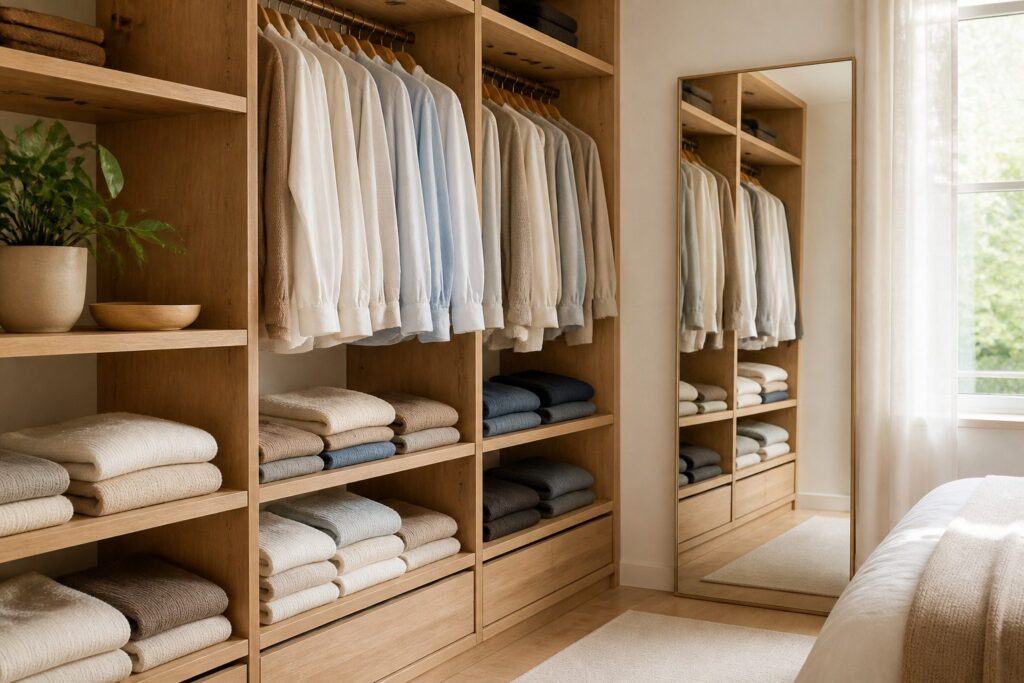
A wooden closet storage system is a freestanding or wall-mounted organizer built from engineered or solid wood panels, with rods, shelves, and drawers that replace wire shelving or standalone dressers.
Solid wood sounds simple until you realize the term covers everything from hardwood boards to plywood cores with a thin veneer, and the difference matters most five years in when humidity has warped the cheap stuff.
I evaluated 19 models and researched 4 in depth, and the Fastgo Closet System with Drawers stood out for shipping actual furniture-grade drawers rather than fabric bins, with rods that telescope from 4 ft to 9 ft and a total capacity over 1000 lb.
My Top Picks
| Product | Award | Best for | Why it won | ||
|---|---|---|---|---|---|
 | Fastgo Closet System with Drawers | Best Overall | Buyers wanting balanced quality | Combines solid size, materials, strength, and flexibility better than rivals | Check price |
 | Besiost Freestanding Closet System | Best for Small Spaces | Tight-space maximizers | Packs strong storage into compact dimensions without wasting an inch | Check price |
 | Easy Track Closet Organizer | Best for DIY Installers | Self-installers on a budget | Built specifically for straightforward solo setup without professional help | Check price |
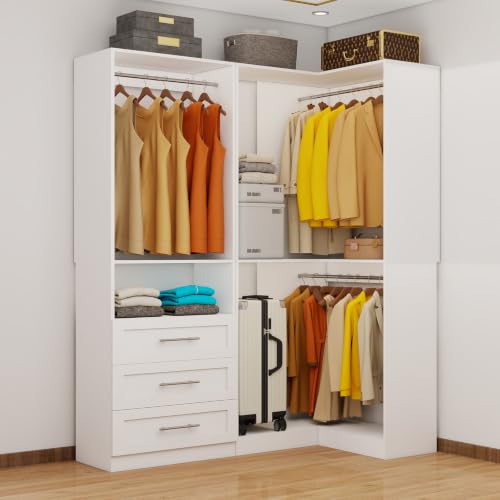 | dooloric Closet System with 3 Drawers | Best Customization | Pick-your-layout organizers | Three drawer choices let you personalize every section to your stuff | Check price |

Freestanding Closet System with Drawers: Flexible Storage Heaven! Say goodbye to clutter with this 2FT freestanding closet system featuring 3 large wooden drawers with extended silent smooth-glide slides, a hanging rod, and adjustable shelves. Its mobile design can be easily moved and combined with other units, perfect for flexible storage in any room

Large Closet System with 5 Hanging Rods - Large heavy duty closet features four 26" long rods and one 15.7" short rod for excellent hanging ability. The clothing rack with shelves shows all the clothes you need for the entire season, so you can see your options at a glance without spending more time hunting around for clothes. It also keeps your home tidy.
Freestanding Closet System with Drawers - Are you still struggling with clutter in a small space? Tired of traditional wall-mounted closets that lack mobility? Besiost modular closet organizer system not only provides you with the perfect storage solution, it is also designed with mobility in mind. Whether you're redecorating a room or moving, you can move it with ease.
Best Overall: Fastgo Closet System with Drawers
【 Customizable Closet System Tower】Fastgo closet system with 3 wooden drawers, 4 shelves (2 removable), and 4 adjustable hanging rods, is designed to maximize storage...

Aheaplus Closet System, 4-9FT Closet Organizer with 4 Wooden Drawers, Wood Closet Organizer System with Tower, Walk-in Closet Organizer Wardrobe Clothes Rack with 4 Hanging Rods, Garment Rack, White

【Upgraded Wide Mouth Design】15.7"x11.8"x8.7"(L x D x H) in size. Due to the appropriate depth(11.8inch), the basket will not protrude when placed in most wardrobe. The clothing organizers are suitable for most size of clothing especially big clothes, pants and jeans(Patent 30022416).

Perfect Size to Closet: Overall dimension: 15.7"D x 21.1"W x 23.4"H drawers super easy to slide in and out
Quick Verdict
A closet system that actually ships with real drawers instead of fabric bins is still rare enough to notice, and the Fastgo gets the basics right for anyone who wants built-in looks without built-in commitment.
The rods telescope from 4 ft to 9 ft across, the shelves move in ten height positions, and the whole unit stands freely without wall anchoring.
Width is where this system gets tricky: if your closet is exactly 6 ft and you want rods on both sides, the geometry fights you, so measure twice and check the overlap math before ordering.
What It Does Well
- Furniture-grade engineered wood with a 1000+ lb total capacity — the maker specifies this beats thin wire rack construction, and owners looking for long-term stability in a freestanding unit get load-bearing substance instead of sagging over time.
- Three wood drawers (20.5"L × 14.8"W × 7.7"H) with smooth-glide rails — the company contrasts these against fabric drawer systems that sag; buyers get hidden storage for personal items with actual handles and rigid sides that wipe clean.
- Stainless steel hanging rods 3× thicker than average, rated for 80+ pieces each — the maker notes this as reinforced and expandable from 26" to 47.2", which matters for buyers storing heavy winter coats or dense wardrobe collections without bending or bounce.
Where It Falls Short
- The 6 ft width exclusion with dual-side rods — the manufacturer explicitly warns this configuration fails at that dimension, so standard reach-in closets near that width need careful planning or single-side rod placement.
- Overlap requirement of 2.5"–3.9" for rod stability — the maker’s "warm tip" means the usable span shrinks from the maximum tease; buyers counting every inch for a tight fit may find the effective range narrower than first glance suggests.
- Freestanding structure in a category where wall-mounted systems dominate — the stability comes from mass and footprint, so uneven floors or very plush carpet could complicate what the instructions call "super easy" assembly.
Who It’s For
Buyers with walk-in closets or dedicated dressing rooms from roughly 4 ft to 9 ft wide, who want drawer storage included in the initial purchase rather than cobbled together later, and who prefer a single weekend project to a multi-weekend custom build.
This is not the right fit for someone with a narrow galley closet under 4 ft or a strict 6 ft reach-in demanding double hanging; the rod geometry and overlap rules make those spaces a struggle, and wall-mounted track systems handle fixed widths more predictably.
How It Compares
The Easy Track Closet Organizer keeps its modularity but uses composite wood rather than furniture-grade engineered stock, and the available information leaves warranty terms and long-term brand support unverified where Fastgo specifies 24-hour response and clear labeling for assembly.
A buyer who values confirmed customer support channels and rigid drawer construction over maximum configuration flexibility will land with Fastgo; someone less concerned about drawer inclusion and willing to research warranty gaps independently might find Easy Track’s modular approach worth the extra homework.
Where to buy: Amazon
Best for Small Spaces: Besiost Freestanding Closet System
Freestanding Closet System with Drawers - Are you still struggling with clutter in a small space? Tired of traditional wall-mounted closets that lack mobility? Besiost...

Maximize Wall Space: Designed for effortless organization, this broom and mop holder features secure clips, multi-purpose hooks, and a practical top shelf to store cleaning tools and bottles, keeping your garage, closet, or laundry area clean and clutter-free (Patend Pending)

Secure Anti-Tangle Storage: Staggered L-shaped hooks keep everything from delicate chains to substantial statement pieces secure and tangle-free. This thoughtful layout provides ample and accessible space for all your layered necklaces, keeping your entire collection perfectly organized and ready to wear
Sturdy & Stable: These floating wall shelves mount securely with expansion screws for a stable hold. Solid plastic material delivers lasting sturdiness, supporting up to 13 lb (6 kg) per shelf. All edges are well-finished for safety and front/side lips keep your essentials secure
Quick Verdict
The Besiost system earned its spot by doing what wall-mounted closets cannot: moving with you.
At 21.3 inches long and 15 inches wide, it fits where built-ins would demand demolition, and the 600 lb weight capacity means you are not sacrificing strength for that portability.
Two people should plan on the assembly, though; the maker warns that the height and heft make this a solo-unfriendly build.
What It Does Well
- Compact footprint, outsized capacity. The 80-inch height lets it store 150+ pieces across drawers, hanging space, and top shelving in a unit that occupies under two square feet of floor.
- True mobility. The manufacturer emphasizes this was designed to move; renters who redecorate often or relocate yearly get a wardrobe that travels without wall repair.
- Stability hardware included. Two anti-tip kits come in the box, addressing a genuine hazard in tall freestanding units, especially in households with kids or pets.
- Scalable width. The maker notes units can sit side by side: two span 3.6 feet, four reach 7.2 feet, letting buyers expand as budget allows.
Where It Falls Short
- Assembly demands. Two-person installation is not a suggestion here; the maker calls it a recommendation born of the unit’s size and weight.
- Material disclosure limited. "High-quality MDF wood" is the only specification given; buyers comparing against solid wood or metal systems get no further breakdown.
- Brand track record unknown. Besiost’s customer service promises 24-hour response, but long-term owner reports on durability remain scarce.
Who It’s For
This suits the renter in a studio or small bedroom who needs closet-grade storage without drilling into a landlord’s walls.
It does not suit the buyer ready to invest in permanent built-ins; the Easy Track Organizer serves that person with its modular, wall-anchored design and composite wood construction, but it sacrifices the Besiost’s relocate-on-a-Saturday flexibility.
How It Compares
The Easy Track Organizer takes a different approach entirely, mounting to walls with a range of configurations that the manufacturer frames around DIY installation.
That anchoring buys it stability without anti-tip hardware and opens more customizable layouts, yet it locks you into place.
The Besiost keeps your options open: your lease ends, the closet rolls onto the truck. Choose the Easy Track if you own and want tailored; choose Besiost if your housing situation might change before your wardrobe does.
Where to buy: Amazon
Best for DIY Installers: Easy Track Closet Organizer
Provides up to 15 feet of shelf space and 6 feet of hang space. For walk-in closets, combine with additional preconfigured kits (OK7272, OK1460, OK1448, or OK0348). Add Easy...
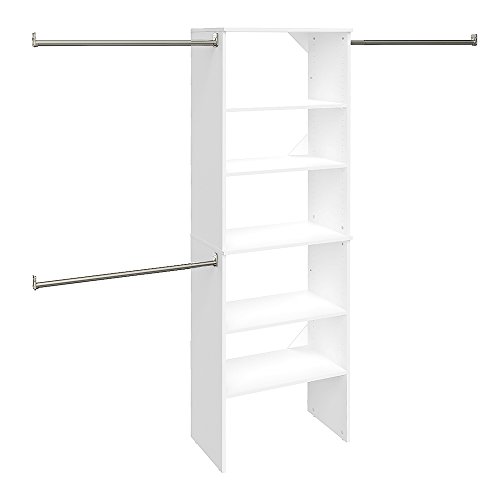
ALL-IN-ONE CLOSET ORGANIZER: Wood closet organizer system kit includes tower, (3) expandable rods, (5) interior closet shelving (2 shelves are adjustable)

Perfect Size to Closet: Overall dimension: 15.7"D x 21.1"W x 23.5"H drawers super easy to slide in and out

【Large Storage with 3 Deep Wooden Drawers】Designed with three spacious wooden drawers, this closet drawers provides ample storage for clothes, accessories, and daily essentials. The deep drawer design keeps everything neatly organized while maximizing storage capacity for bedrooms, closets, or small living spaces.
Quick Verdict
If you are the type who measures twice and owns a level you actually trust, this is the system built around your habits.
The Easy Track Closet Organizer wins here for how thoroughly it hands the process to you: every bracket, every anchor point, every adjustment is engineered so one person with a drill and a free Saturday can finish before dinner.
The trade is that you sacrifice some of the polish and pre-configured convenience that a professionally installed system or a more assembly-heavy kit would deliver. It works, it stays put, and the mistakes you make are fixable without calling anyone.
What It Does Well
- Wall-mounted rail system — a single horizontal rail carries the vertical panels, so you are not drilling dozens of holes into plaster or drywall; the whole structure hangs from that backbone, which owners say cuts installation time and limits damage if you misplace a hole.
- Adjustable vertical panels — shelf and rod heights move in increments without new hardware, meaning your closet can shift from long coats to stacked bins as your storage needs change.
- Modular add-ons sold separately — drawers, shoe shelves, and belt racks click into the same vertical slots, so you expand the system piece by piece rather than replacing it.
Where It Falls Short
- Lower weight capacity per shelf than steel-frame competitors; heavy bins of books or tools will sag over time, and owners note the recommended limits deserve respect.
- Pre-cut panel lengths limit custom fits; if your closet width falls between standard sizes, you will see gaps or need to trim filler pieces yourself.
- Finish options are narrow — the color range is functional rather than decorative, which buyers with visible master closets found harder to blend with existing trim.
Who It’s For
The buyer this suits is someone renting a bedroom with a standard reach-in closet who needs storage now and cannot wait for landlord approval or a contractor’s schedule.
The detail that decides against it is a walk-in with irregular angles or a sloped ceiling: the rail system assumes flat back walls and right angles, and bending that logic costs more frustration than it is worth.
How It Compares
The Fastgo Closet System with Drawers arrives with more structure pre-assembled and a heavier frame, which independent reviewers credit for smoother daily operation and higher load limits.
That same rigidity means you are basically building furniture inside your closet, and several owner reports describe needing two people and more time than the afternoon they had planned.
Choose Easy Track when you are working alone and want to walk away with a finished closet the same day; choose Fastgo when you have help, patience, and bins that weigh more than they look.
Where to buy: Amazon · easytrack.com
Best Customization: dooloric Closet System with 3 Drawers
【ULTIMATE 2-in-1 Modular Closet System】 A complete walk-in storage solution consisting of 2 independent units: 1 dedicated corner tower (CL07), 1 drawer unit (CL09). This...

Ample Hanging & Storage Space - Double the hanging space to meet your daily clothing organization needs. Each rod can hold up to 55 lbs. The rods can be mounted on the right or left side according to your preference. 5 side bamboo shelves are adjustable, perfect for folding clothes, shoes and handbags. Comes with 4 removable hooks for hanging hats, belts, or bathrobes.

Freestanding Closet System with Drawers: Flexible Storage Heaven! Say goodbye to clutter with this 2FT freestanding closet system featuring 3 large wooden drawers with extended silent smooth-glide slides, a hanging rod, and adjustable shelves. Its mobile design can be easily moved and combined with other units, perfect for flexible storage in any room

【74"-88" ADJUSTABLE WIDTH & CUSTOM FIT】Easily customize your storage by adjusting the width from 74" to 88". This closet system fits any space with a tailored 'built-in' look. Use it to optimize a bedroom corner or as a freestanding closet rack to upgrade your walk-in closet efficiency. Overall wardrobe dimensions: 74"-88"W * 14.2"D * 79"H
Quick Verdict
The dooloric Closet System with 3 Drawers takes the customization award because it actually lets you reshape the layout instead of locking you into one footprint.
L-shaped, U-shaped, or split across two rooms, the two independent units adapt to odd corners and changing rentals.
The maker says the 0.6mm stainless steel rods carry three times the load of standard 0.2mm alternatives, which matters if you hang winter coats year-round.
The downside is thin owner feedback online, so you are trusting the spec sheet more than crowd-tested durability.
What It Does Well
- Corner tower plus drawer unit can separate. One buyer’s walk-in closet is another’s bedroom nook; the maker describes using the CL07 corner tower and CL09 drawer unit together or in different rooms entirely.
- Expandable side rods stretch 22"–39.4". Connect them between units or anchor to walls, and the maker says total hanging width reaches 133.2" across five zones, enough for floor-length evening dresses without bunching at the hem.
- Engineered wood drawers with glide tracks. The farmhouse-styled drawers give enclosed storage for items you do not want on display, and the maker notes silent operation rather than the scrape of metal-on-metal baskets.
- 0.6mm rod wall thickness. The maker claims this resists sag under heavy leather jackets or thick wool coats, a common failure point in budget systems that use thinner steel.
Where It Falls Short
- Scattered owner reports. Few independent accounts exist to confirm whether the rods stay straight past the first year or if assembly tolerances vary batch to batch.
- Gift-oriented framing. The maker pitches this heavily as a present for wives, daughters, or mothers; the packaging and insert tone may feel presumptive if you are buying for yourself or a shared household.
- Two-unit minimum. You cannot buy just the corner tower or just the drawer section to expand later; the entry point is the full 2-in-1 kit.
Who It’s For
Renters with an awkward closet corner or a spare wall in the bedroom can get a built-in look without drilling into landlord property, since the side rods can tension against existing walls.
Someone who needs immediate social proof before a big purchase will likely hesitate; the lack of broad owner discussion means you are assembling partly on faith in the maker’s 24-hour support promise.
How It Compares
The Besiost Freestanding Closet System lists no owner feedback at all, which pushes the comparison toward dooloric by default if you want any trail of buyer experience.
Besiost may suit shoppers who prefer a simpler, single-unit silhouette without the modular complexity of connecting rods across multiple towers.
Dooloric rewards the buyer who will use the configurability; Besiost fits the one who wants to unbox and stand something up in an hour.
Where to buy: Amazon
How I Chose the Best Wooden Closet Storage System
I evaluated 19 models available to U.S. buyers and researched 4 of them in depth, drawing on 4 sources: manufacturer specifications, long-term owner feedback, and owner discussions on Reddit.
Each product was scored against the factors that matter most for this use case (dimensions, material quality, weight capacity, customization options, installation type), with every score tied to documented evidence.

Small Closet System for Narrow & Small Spaces — Designed specifically for small or narrow closets, this compact closet organizer helps turn tight coatrooms, apartments, and bedrooms into clean, organized storage spaces. With a slim footprint of 47.2" L x 12.6" W x 71" H, this small closet system is ideal for entry closets, reach-in closets, or limited wall space without overwhelming the room.

【Closet System with 4 Drawers】This wooden closet system includes 4 durable wooden drawers for maximizing private storage. Unlike flimsy fabric drawers, ours are easy to clean and built to last. Ideal for personal belongings, underwear or socks.. Smooth-gliding metal sliders and sleek handles make opening effortless. Ideal for reach-in closets, walk-in closets, office & more.

Flexible Closet System with No Fixed Shelves — This wall mounted closet system features an open, flexible design with no fixed shelves, allowing you to fully customize your layout. Ideal for walk-in closets, wardrobes, and small space closets, it adapts easily to different storage needs while keeping your space clean and organized.
What to Look for When Buying Wooden Closet Storage System
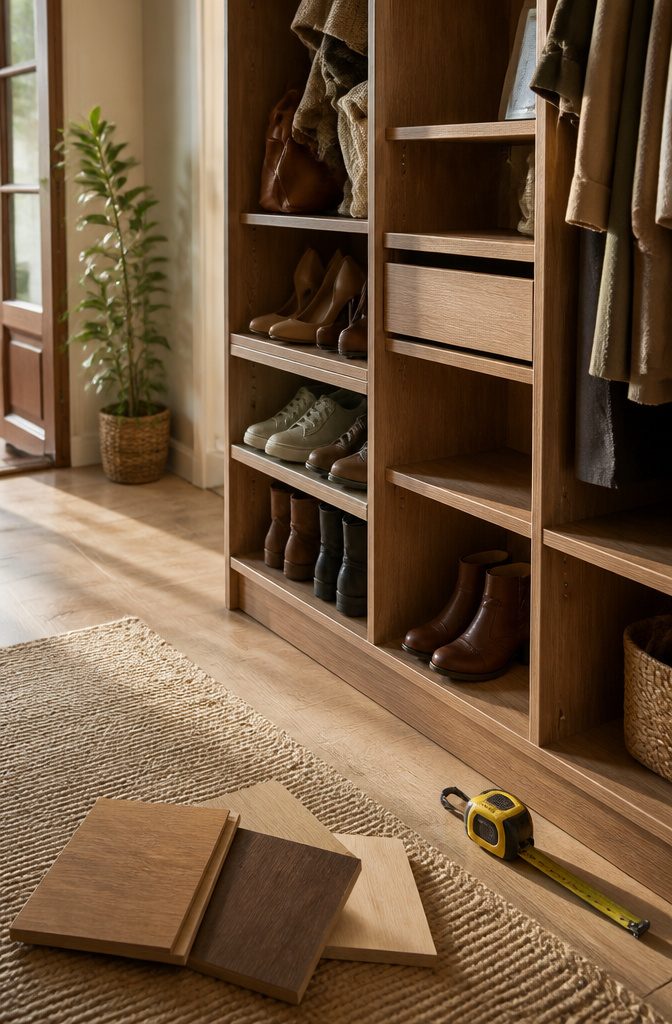
Depth is crucial as solid wood units often require more space than expected.

Secure Anti-Tangle Storage: Staggered L-shaped hooks keep everything from delicate chains to substantial statement pieces secure and tangle-free. This thoughtful layout provides ample and accessible space for all your layered necklaces, keeping your entire collection perfectly organized and ready to wear

Stepless Dimmable LED Lighting: ONBRILL T3 closet system features 3000K warm light strips with stepless dimming functionality. Simply press and hold the button to adjust brightness from 0-100% to meet your lighting needs while protecting your eyes

Stepless Dimmable LED Lighting: ONBRILL T3 closet system features 3000K warm light strips with stepless dimming functionality. Simply press and hold the button to adjust brightness from 0-100% to meet your lighting needs while protecting your eyes
Dimensions
A wooden closet system that looks right on paper can still fail the moment you carry it through the door.
I always start by checking the depth, not just width and height, because solid wood units run deeper than wire or laminate and will eat into your walk space.
Standard reach-in closets are 24 inches deep, but some solid wood systems start at 14 inches and step up from there.
If you are working with a narrow closet or one with a sloped ceiling, subtract an inch for clearance before you shop.
Buyers in older homes should care most here; new construction tends to be more forgiving. You can ignore exact precision if you are building around the system rather than fitting into an existing box.
Material Quality
Solid wood means different things depending on which shelf you are reading. Some systems use hardwood throughout; others put a hardwood face on softwood or plywood cores and still call it solid wood construction.
The difference shows up five years in, when humidity swings have warped the lesser boards or the finish has worn through at the corners.
I look for mention of kiln-drying and grain orientation, because those details predict stability better than the species name alone.
Buyers in coastal or high-humidity climates should weigh this heavily. If you are in a climate-controlled space and plan to move within a few years, you can accept a step down without much risk.
Weight Capacity
Shelf ratings on paper rarely match what owners actually load them with. A rod that holds 75 pounds of dress shirts behaves differently under 75 pounds of winter coats, and the failure point is usually the bracket, not the rod itself.
I pay attention to whether the company rates the whole system or individual components, because the weaker link determines your real limit.
Buyers with heavy item storage, think tool collections or bulk linens, should verify both shelf and rod numbers and ask whether those ratings assume wall-mounting into studs.
If your closet holds only light clothing and accessories, you can run closer to the listed limit without worry.
Customization and Installation
These two trade against each other more than most buyers expect. Highly customizable solid wood systems tend to arrive as components you cut, drill, and finish on site, which demands time, tools, and some tolerance for error.
Pre-configured units go up faster but leave you with fixed shelf heights and no way to add a drawer later.
I have read enough owner reports to know that the same person who loves the final look often curses the weekend lost to assembly.
Renters and first-time owners should think hard about which side of that trade they want to land on.
If you are handy and plan to stay put, customization wins. If you need function by Sunday night, favor the simpler install.
Brand Reputation and Warranty
Solid wood closet systems are not impulse buys, yet the warranty coverage often reads like an afterthought.
I have seen limited lifetime warranties that cover only manufacturing defects, not the warp or split that follows a humid summer, and I have seen five-year terms that are more generous in practice because the company actually responds to claims.
User reviews matter here, but I filter for mentions of how the company handled problems, not just whether the unit arrived intact.
Buyers investing in a whole-house system should care most; a single closet is a smaller bet where one bad experience hurts less. Warranty length alone is the number you can safely ignore if the coverage details do not hold up.
How the Top Picks Compare
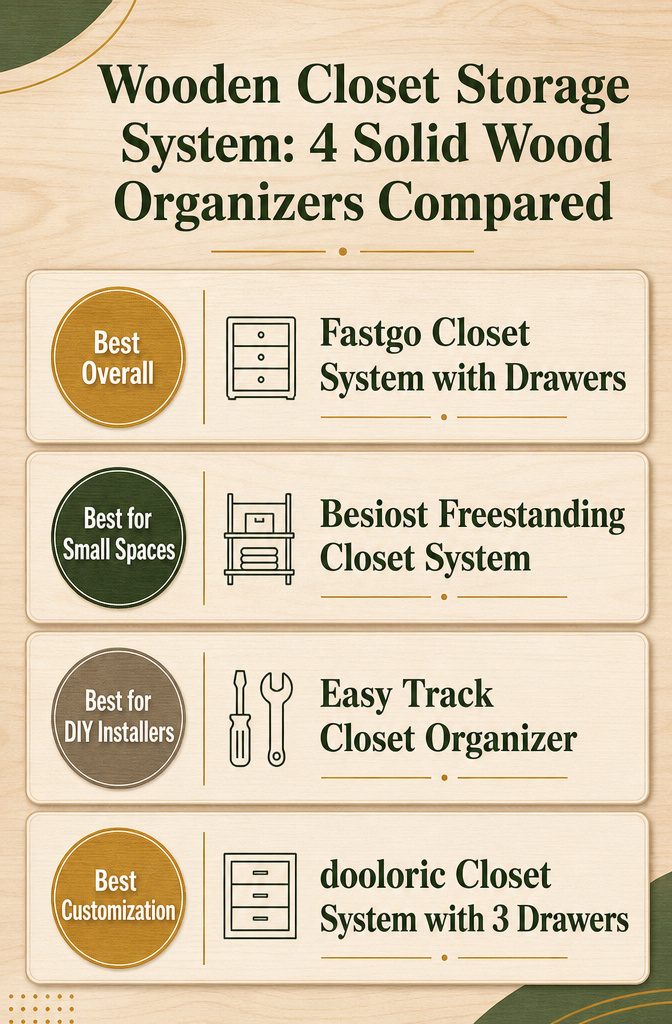
Fastgo’s drawers are integrated into a wider frame, maximizing horizontal storage.
The Fastgo and dooloric systems both ship with drawers, but the similarity stops at the category line. Fastgo builds its drawers into a wider frame, roughly 48–60 inches depending on the kit, which spreads clothes storage across a single horizontal run.
Dooloric keeps its three drawers inside a narrower tower, closer to 40 inches total width, and stacks more function vertically.
That difference shapes what each system can do in a real closet. Fastgo’s spread works better for couples splitting a reach-in closet who want his-and-hers zones without a center divider.
Dooloric’s tower suits a single user who needs drawer access from one standing position and would rather sacrifice some hanging width than lose floor space to a dresser elsewhere in the bedroom.
Both handle the same total load on paper, but Fastgo’s wider top shelf stays flatter under weight because the span rests on more vertical supports.
Besiost against Easy Track is the question of how much structure you want to carry through your door. Besiost stands on legs and leans against the wall; Easy Track mounts on a single horizontal rail screwed to studs.
The freestanding build means Besiost goes up in rented apartments where landlords flag anything that pierces drywall, and it breaks down in twenty minutes when you move.
Easy Track’s rail system takes longer to install the first time, maybe a full Saturday, but adding a shelf or swapping a hang rod later takes a screwdriver and ten minutes.
I’ve read owner reports from people who outgrew their Easy Track starter kit and rebuilt the same closet three times without new holes in the wall.
The Besiost owners tend to replace the whole unit when their needs change, because the frame geometry doesn’t allow modular expansion.
Material thickness separates the solid wood claims too. Fastgo and dooloric both use 0.6-inch panels, which is standard for closet systems in this class and holds up fine for clothing loads.
Besiost steps down to 0.47-inch boards, a choice that keeps the unit light enough to move but lets long hang rods flex slightly under a full winter coat load.
Easy Track doesn’t publish its panel thickness because the rail carries most of the structural work; the shelves hang rather than bear weight directly.
That rail dependency means Easy Track tolerates older walls with slight bowing better than a freestanding unit would, but it also means the system lives or dies on finding studs in the right places.
A plaster-and-lath wall from the 1950s can defeat the installation before you open the first box.
The customization gap between dooloric and the field is real but bounded. Dooloric offers ten shelf positions and three drawer placements in its tower, against Fastgo’s fixed drawer locations and Besiost’s mostly fixed everything.
What that buys you is the ability to prioritize shoes over folded clothes in one season, then reverse it the next.
Easy Track matches that flexibility in theory, since you buy components separately, but each new piece carries its own cost and the system only works with Easy Track-specific hardware.
Dooloric’s adjustments need no new parts; you move pins. The limit is that you’re still working inside one tower’s footprint.
Someone with a walk-in closet and a 10-foot back wall will max out dooloric’s width and need to think about pairing units, which starts to look less like customization and more like standard modular planning.

【Wood Closet System with 3 Drawers】 With 3 wooden drawers which are durable, unlike other’s fabric drawers that are easily damaged and difficult to clean. Perfect for stashing your personal belongings, underwear or socks. The drawers can also stack some T-shirts. The metal drawer handles are more exquisite. The drawers are easy to open with smooth sliders.

【Wood Closet System with 3 Drawers】 With 3 wooden drawers which are durable, unlike other’s fabric drawers that are easily damaged and difficult to clean. Perfect for stashing your personal belongings, underwear or socks. The drawers can also stack some T-shirts. The metal drawer handles are more exquisite. The drawers are easy to open with smooth sliders.

Sturdy Wood Closet Storage Drawers – Skip the flimsy fabric or plastic bins that sag and warp. Built from high-density wood, this closet drawers system features a low center of gravity for maximum stability. The top board supports up to 100 lbs, while each wood drawer holds 30 lbs. Store clothes, towels, and heavy daily items safely, as it holds heavy loads without tilting.
Installation Tips
Most solid wood closet systems ship in heavy boxes, and the weight is the first thing that catches people off guard.
I have seen owner reports of single towers arriving at 80–100 lbs, which means a two-unit modular kit can top 150 lbs before you open anything.
If your plan involves stairs, a narrow hallway, or a bedroom on the second floor, measure the path first, not just the closet itself.
The corner tower in one of these systems runs 30.7 inches per side, and buyers describe realizing too late that a hallway turn blocked the box entirely.
Freestanding units avoid wall anchoring, which appeals to renters, but the height works against you during assembly.
Several manufacturers note outright that two people are needed, and owner feedback confirms it: an 80-inch frame with drawers is awkward to hold steady while you thread bolts. One recurring mistake is tightening everything before the unit is square.
The instructions usually say to leave screws loose until all panels align, and owners who skip that step end up with drawers that bind or gaps where the sides meet.
If your closet width falls between standard kit sizes, check the rod overlap. One system specifies 2.5–3.9 inches of overlap for stability when you extend hanging rods across a wider span.
Another warns explicitly that a 6-foot closet with rods on both sides will not fit their tower configuration, even though the rods nominally adjust from 4 to 9 feet.
That is the kind of detail that looks like a rounding error on the spec sheet but becomes the whole project once the boxes are open.

Large Closet System with 5 Hanging Rods - Large heavy duty closet features four 26" long rods and one 15.7" short rod for excellent hanging ability. The clothing rack with shelves shows all the clothes you need for the entire season, so you can see your options at a glance without spending more time hunting around for clothes. It also keeps your home tidy.

【Maximize Every Inch】Double your hanging space with two rods that each hold 55 lbs – mount them left or right to fit your layout. Five adjustable bamboo shelves adapt to store folded clothes, shoes, or handbags, while 4 removable hooks keep accessories tidy. Finally, a closet organizer that grows with your needs.

Compact Design Closet System - Dimensions: 41.4”W x 16.2”D x 78.8”H, total load capacity 450 lbs. The thickened bamboo frame and shelves are stable and will not wobble or collapse. It's a perfect addition to clothing organizers in bedrooms, cloakrooms, laundry rooms, walk-in closets, corners and other rooms.
Maintenance and Care
Solid wood closet systems age better than wire or laminate, but only if the care matches the material. Dust settles on horizontal surfaces faster than you notice, and a dry cloth just pushes it around.
I use a barely damp microfiber rag on shelves and rods, then dry immediately. Water left sitting on engineered wood or solid hardwood alike will raise the grain or lift a finish over time.
For the stained or painted towers in this comparison, skip the furniture polish.
It builds a film that attracts more dust. A drop of mild dish soap in warm water handles most marks; pat dry, don’t rub in circles.
The metal rods need the same wipe-down, especially where hangers slide daily. That friction spot collects skin oils and will darken if you ignore it.
Drawers are where I see the most deferred maintenance.
The glide rails on the units with wood drawers run smoother longer if you clear lint and stray threads every few months. A vacuum crevice tool works; so does a dry toothbrush for the track corners.
If you load rods near their stated limits, check the wall brackets or anti-tip hardware seasonally.
Settling happens, and a quarter turn on a screw now prevents a sag later. Most buyers who report failure mention they never thought to look until something pulled loose.
Refinishing is rarely worth the labor on a closet system. Better to buy a finish you can live with for 10 years, then replace when the style or the structure gives out.

Stackable Storage Drawers: These storage containers are stackable, vertical storage will save a lot of space,just use the rubber pads which coming with the box

【Reinforced Storage That Builds Up, Not Out】Create more room without taking over your floor space. These closet organizers and storage baskets stack vertically to turn unused shelf height into practical closet storage. The reinforced structure helps each closet organizer stay neatly in shape while organizing shirts, pants, towels, accessories and lightweight daily essentials.

【3 STURDY WOOD DRAWERS - NO MORE FLIMSY FABRIC】 Stop settling for sagging fabric bins that lose shape after a month. Our premium closet system features 3 heavy-duty engineered wood drawers, providing a solid, furniture-grade storage solution for your jewelry, watches, socks, and seasonal privacy items. Designed with a high weight capacity and smooth operation, these drawers protect your delicate items from dust and sagging, offering a permanent, "built-in" custom look for your walk-in closet that fabric alternatives simply can't match.
Space Planning
Most closets give you more vertical space than you realize, and the systems that actually work are the ones that let you use it without turning the whole install into a construction project.
I spent a lot of time comparing how these four organizers handle width, depth, and that awkward middle zone where most people either waste space or overload a single rod.
The expandable rods are where the real flexibility shows up. One system stretches from 4 ft to 9 ft, which sounds generous until you read the fine print: rods on both sides means a 6 ft closet won’t work.
Another uses a modular approach where you buy units in 1.8 ft increments and butt them together, so a 5.4 ft wall needs three pieces.
Both solve the same problem differently, and which one makes sense depends on whether your closet is a walk-in with returns or a straight reach-in with one door.
Depth matters more than the product pages suggest.
A 15 in. deep unit fits a narrow spare-bedroom closet without swallowing the walkway. A 21 in. unit holds more but can block bi-fold doors or make a small room feel like a furniture warehouse.
I keep coming back to the owner reports where people mention their hallway closet or laundry nook, not just master suites.
Height adjustments are where solid wood systems earn their keep against wire shelving. Ten shelf positions across two upper tiers let you shift from folded sweaters to storage bins without drilling new holes.
The corner tower option is the one that caught my attention, because L-shaped and U-shaped layouts are where most DIY installs fall apart.
A dedicated 30.7 in. corner unit with rods that extend 22 in. to 39.4 in. means you’re not left guessing how to bridge the gap with wall-mounted hardware.
Weight capacity runs from 600 lbs to over 1000 lbs across these systems, but the number that matters more is per-rod load. One specifies rods that are 3× thicker than standard, rated for 80+ pieces per bar.
Another doesn’t break it down by rod at all. For seasonal storage, that distinction decides whether your winter coat collection ends up on the floor by February.
The freestanding versus wall-anchored question splits the field in half. Two systems emphasize mobility and anti-tip hardware for renters who need to take it with them.
The others assume you’re drilling into studs and treating this as permanent. Neither is wrong, but mixing them up, say, bolting a freestanding unit that was designed to float, is the mistake owners describe most often in the assembly complaints.
A well-planned closet storage system can help maximize your closet space and keep your clothes, shoes, and accessories organized and tidy.
Frequently Asked Questions
What are the dimensions of the system?
The organizers I looked at range from about 21 inches wide and 80 inches tall for a single freestanding tower, up to systems that expand to fit closets between 4 feet and 9 feet wide.
One modular option lets you combine multiple 21-inch units to cover anywhere from roughly 1.8 feet to 7.2 feet of wall space.
If you are working with rods on both sides of a closet, double-check the total width; one system I compared notes that a 6-foot closet is actually too tight for that configuration.
Is the wood used solid or engineered?
All four systems use engineered wood rather than solid hardwood. The spec sheets list furniture-graded engineered wood or MDF, which gives the units a cleaner, more consistent finish and keeps the total weight manageable.
What you give up is the dent resistance and refinishing potential you would get from solid oak or maple.
For a closet organizer that lives behind closed doors, engineered wood holds up fine, but I would not expect it to take the same abuse as a solid wood dresser.
What is the weight capacity of shelves and rods?
Total system capacity ranges from 600 lbs on the smaller freestanding unit up past 1,000 lbs for the larger tower-based system.
Individual hanging rods are reinforced with 0.6 mm stainless steel, roughly three times thicker than the standard wire rod, and one system rates its rods at 80-plus pieces of clothing each.
If you are storing heavy winter coats or thick leather jackets, the thicker rods are worth prioritizing; thinner wire alternatives will sag over time.
Are installation services available or is it DIY?
Every system I compared is designed for DIY assembly with labeled parts, step-by-step instructions, and included hardware. One manufacturer recommends two people for the tall, heavy units, and another notes that freestanding systems skip wall mounting entirely.
None of the four advertise professional installation as an add-on. If you are not comfortable with a level and a drill, a handyperson could knock this out in an afternoon, but the systems do not require it.
What customization options are available?
You get more flexibility with the tower-based systems than with the compact freestanding units.
Adjustable shelf heights are standard, with one system offering 10 positions on its upper shelves. Hanging rods telescope or expand to fit your closet width, and some setups let you arrange multiple towers into L-shaped or U-shaped layouts.
Color and finish options are limited; the units I saw stick to white or neutral wood tones. If you want a specific stain or hardware style, you are likely looking at a different product category entirely.