
A kitchen cabinet pull down shelf is a mechanical storage system that lowers upper cabinet contents to counter height so you can reach them without stretching overhead.
What stops most people is the clearance it demands: most two-tier systems pull forward 14 3/4 inches from the cabinet face, which blocks prep space and rules out installation above stoves or deep counters.
The Rev-A-Shelf gas-assisted model, the one most buyers recognize, drops 10 inches and locks in place using steel shelves rated for 25 to 50 pounds depending on the width you choose.
Rev-A-Shelf Two-Tier Pulldown System
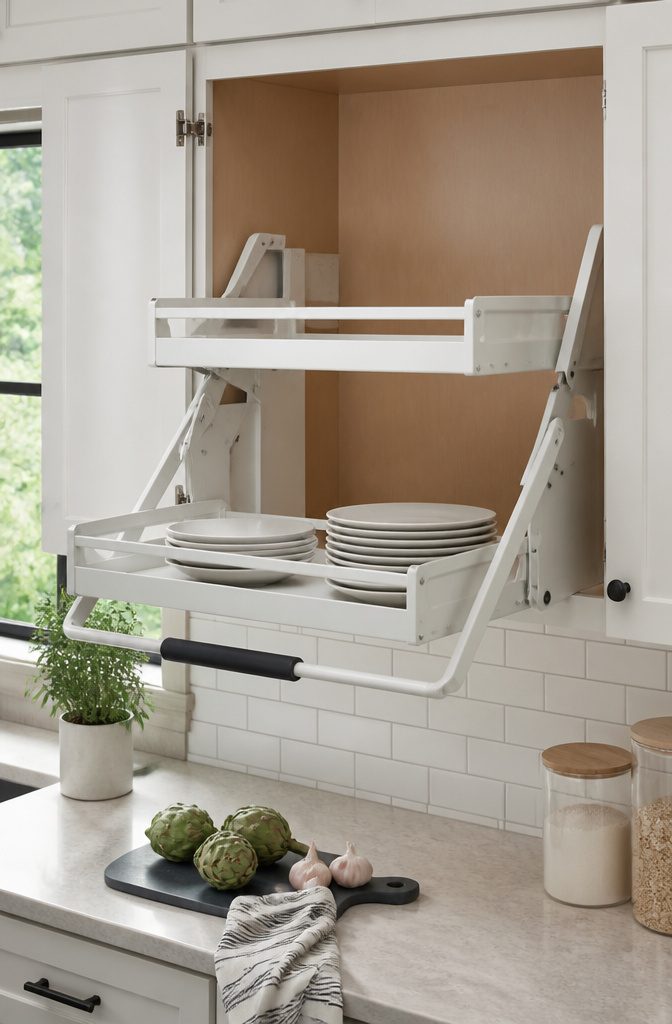
The Rev-A-Shelf Convenient Wall Cabinet Pulldown Shelf System is what most people picture when they search for a kitchen cabinet pull down shelf, and for good reason.
It is a two-tier steel shelf that drops 10 inches using a gas-assisted mechanism and locks in the lowered position, which means both hands stay free for loading or unloading plates.
You can get it in 24-inch or 36-inch widths, and it pulls out 14 3/4 inches from the cabinet face, so the clearance below matters as much as the width inside.
The Rev-A-Shelf Convenient Wall Cabinet Pulldown Shelf System is exactly what you’d expect it to be… The steel organizer is available in 24-inch or 36-inch options, so it’s super important to measure your upper cabinet and make sure it will fit. It also pulls out 14 3/4 inches away from the cabinet, so you’ll need that clearance below.
That pullout distance is the detail that trips people up.
A 14 3/4-inch reach in front of the counter blocks most prep work while the shelf is down, so I would plan the install away from the main cooking zone if the layout allows it.
The 10-inch lowering range suits standard 30-inch upper cabinets well enough, but in a 36-inch cabinet with a high mount, the top shelf still sits above eye level for most users.
I would pick the 24-inch width for a single stack of dinner plates and the 36-inch only if the cabinet run has the depth to match; a wide shelf with shallow storage behind it wastes more space than it solves.

Size & Capacity: This pull-down cabinet organizer for wall cabinets measures 22.25"W x 10.5"D x 18.38"H and includes 2 shelves for storage. It can hold up to 17 lb. and pulls down as low as 10".

HOUSE AGAIN Pull-Down Cabinet Organizer for High/Deep Cabinets, Drop Down Spice Rack, 12.6" Out & 1.8" Down, Dual Install, Fits Frameless, for Spices, Snacks and Small Bottles (Black)

Durable 4 pack Spice Rack: Built with sturdy powder-coated metal, this wall mount rack won’t bend or warp under long-term heavy loads. It stays rigid in humid kitchens and with everyday use, free from sagging or deformation. Ideal for home and commercial spaces alike.
Manual Pull Down Shelves

Manual pull down shelves run on springs or basic hinges rather than gas shocks, and they occupy the budget end of the market where most renters and first-home owners actually shop.
These systems suit standard kitchens and retrofit projects where cost efficiency matters more than premium positioning.
Expect to spend between $200 and $1,000 for a complete unit, though owners on Reddit mention that bare-bones bracket-and-strut setups they hoped to build themselves rarely materialize under $50 once hardware is sourced.
The standard sizes that work here are the common wall cabinet widths: 24-inch, 30-inch, and 36-inch boxes, with shelf depths of 10 to 14 inches.
A spring mechanism handles lighter loads well, around 15 to 20 pounds of dishes or dry goods, but you give up capacity for that simplicity.
The motion is not as damped as gas-assisted alternatives, so the shelf can return with more snap than you want if your hands are full.
I would pick a manual system for a single project in a rental where I am not sure I will stay long enough to amortize a premium lift.
I would skip it for heavy mixers or daily-use cookware; the hardware fatigue shows faster under constant load, and replacement parts for budget mechanisms are harder to source than those from established brands like Rev-A-Shelf.

【Gas-Assisted Lift with Smooth Lowering Motion】 This pull down shelf features gas-assisted lift with smooth lowering motion, helping bring stored items closer with less effort. The entire 3-tier rack moves down together, allowing easy access to bottles, jars and spices, ideal as a pull down spice rack for cabinet to simplify spice organization for cabinet.

【Pull-Down Spice Rack】: Easily access items in high cabinets. This pull-down rack lowers spices, canned goods, and bottles to a comfortable height (extending 21 inches deep), making cooking more relaxed—no more climbing or straining to rummage through the cupboard.

IMPORTANT SIZE NOTICE- 2-Tier Pull Down Shelf Dimensions: 22-24" W (adjustable width) x 11" D(fixed depth) x 22" H (fixed height). MUST MEASURE your cabinet before ordering! Fits standard upper cabinets with: 22-24" width (adjustable);Minimum 22" height clearance;11" depth required
Electric Cabinet Lift Systems
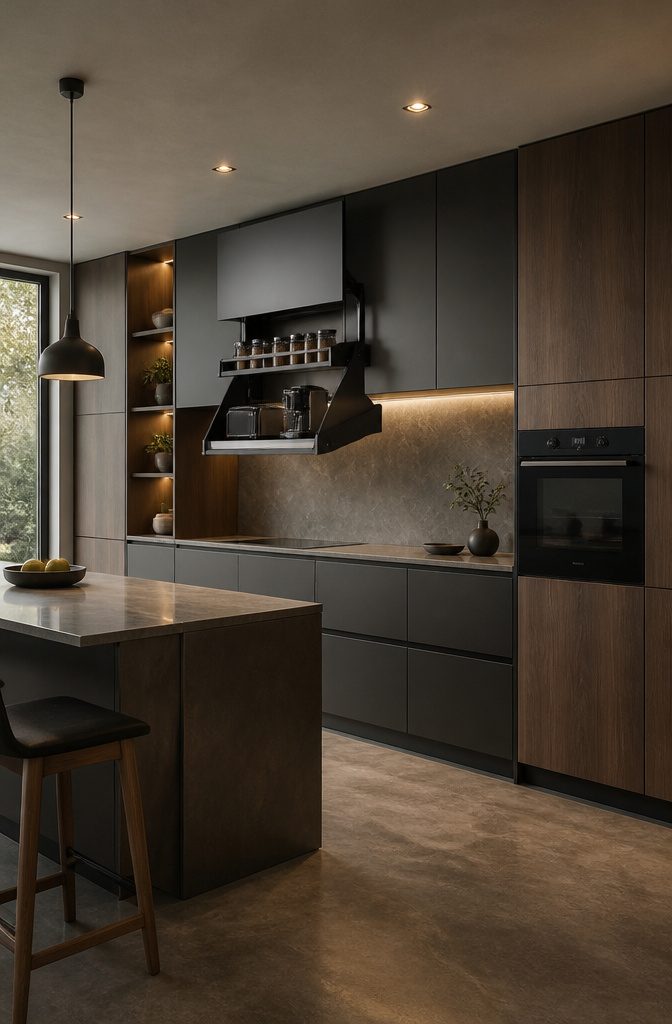
Motorized cabinet lifts trade the gas shocks and tension springs of manual systems for an electric drive that lowers and raises the shelf at the press of a button.
The difference is real accessibility, not just convenience. Someone with limited grip strength or shoulder mobility can operate an upper cabinet without asking for help, and in a smart kitchen the lift can tie into voice control or automated routines.
What has to happen before the first use is the real hurdle. These systems need a dedicated power source inside the cabinet, whether that is a junction box hardwired during construction or a receptacle added by an electrician.
Retrofitting one into finished cabinets runs the cost well past the unit itself, which is why I only point clients toward electric lifts in two situations: new builds where the wiring is still open, and aging-in-place remodels where the premium is justified by daily need.
For a standard retrofit on a weekend budget, the manual systems win. The hardware is simpler, the install is within reach of a careful homeowner, and the failure mode is a spring replacement, not a service call.

365-Day Evaluation: We believe you'll find value in your Ravinte handles. Use them for a full year, and if they don't meet your needs, we're here to help

MEASUREMENT: 10in Center to Center with 12-3/5in Overall Length
365-Day Evaluation: We believe you'll find value in your Ravinte handles. Use them for a full year, and if they don't meet your needs, we're here to help
Pull Down Spice Rack Systems

Narrow pull down spice rack systems sit in a different category from general cabinet shelving, and the distinction matters when you’re deciding where the money goes.
These units typically run 15 to 25 lbs in weight capacity, a lighter rating than broad two-tier systems because the hardware is scaled to a slimmer frame.
The dimensions follow the same logic: most fit cabinet interiors between 4 and 12 inches wide, depths around 10 to 14 inches, and heights that clear standard upper cabinet depths without binding.
The mechanism choice here is simpler than it looks. Spring-based versions cost less upfront but feel less smooth at capacity and wear faster over years of daily use.
Gas shock-based systems descend with more control and hold steady in the lowered position, which matters when you’re reading labels one-handed over a hot pan.
I would pick gas for a spice rack that sees daily rotation, spring only if the budget is tight and the install is temporary.
Wire platforms beat solid shelves for spice bottles; ventilation prevents caked residue on jar rims, and the slight lip of a wire grid stops small bottles from sliding.
The real trade-off is capacity versus visibility. A narrow pull down spice rack organizer lowers everything into your working sightline, but the compact frame limits total bottle count.
If your collection runs past two dozen spices, you are choosing between two narrow units or accepting that some bottles stay on a fixed shelf behind the pull down.

Sturdy and Durable: The product is made of high-quality carbon steel, space aluminum, and tempered glass, using baked paint technology, with high strength, wear resistance, and long service life.

Pull Down Shelf Dimension, 22-24" Width x 11" Depth x 22" Height. Please check the dimensions carefully before placing your order.

Build to Last: This pull-down cabinet shelf mainly adopts tempered glass and aluminum alloy with cutting and nano-coating processes, making it anti-rust, crush-resistant, and high-strength.
Wall Cabinet Lift Baskets
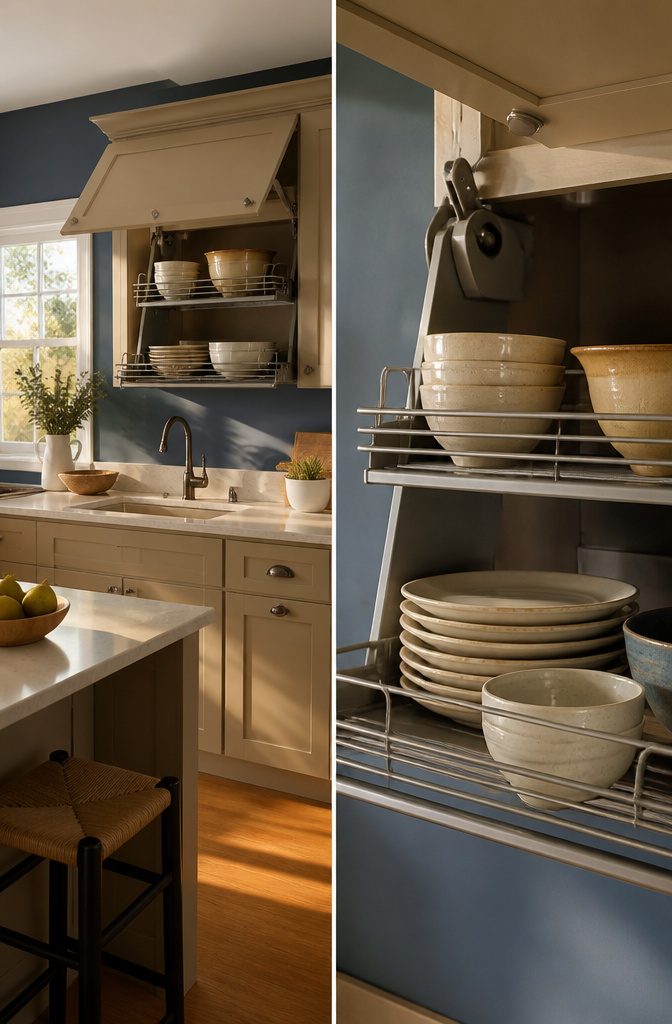
Two-level lift baskets handle the job differently than a flat pull-down shelf because they divide what you store into zones.
The upper basket stays shallow, which keeps plates and bowls visible without stacking, while the lower basket runs deeper for bulkier items like mixing bowls or small appliances.
A flat shelf brings everything down as one surface, but the basket walls keep things from sliding when the unit tilts, and the open wire lets you scan contents from below before you even pull it.
The gas-assisted mechanism on the Rev-A-Shelf system drops the whole assembly 10 inches and locks there, then retracts 14 3/4 inches forward into the room.
That forward motion matters for wall cabinets, because it brings the load past the counter edge so you’re not leaning over to reach inside.
I would put everyday dishes in a lift basket and reserve solid pull-down shelves for heavier, less frequent items like serving platters, where a flat surface supports weight more evenly and the sides of a basket would just get in the way.
You need 14 3/4 inches of clearance below the cabinet face for the forward swing, which rules these out where a range or a deep counter overhang sits directly underneath.
The 24-inch and 36-inch widths match standard cabinet boxes, so the measurement that actually trips people up is that forward arc, not the cabinet width.

Bring it to You: Bring hard-to-reach items to you with this convenient gas-assisted 2-tier cabinet pull-down locking shelving system that is capable of pulling down 11.5-inches and pulling 16.75 inches out of your cabinets.
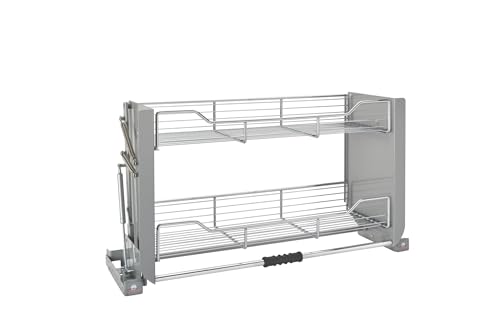
Size & Capacity: This pull-down cabinet organizer for wall cabinets measures 34.25"W x 10.5"D x 18.38"H and includes 2 shelves for storage. It can hold up to 26 lb. and pulls down as low as 11.5".

Size & Capacity: The pull-down closet rod measures 26"W x 4"D x 34.75"H and extends up to 35"W to fit your closet width. This adjustable clothes rod comes with mounting hardware and holds up to 25 lb.
Custom Pull Down Shelf Solutions

Most upper cabinets in older kitchens were not built around a pull-down shelf, so the standard 24-inch or 36-inch Rev-A-Shelf system will not always drop in clean.
A cabinet 30 inches wide with an odd depth, or one sitting above a refrigerator with reduced clearance below, is where I start looking at custom work instead of fighting a retrofit.
The question is whether the modification costs less than replacing the cabinet box itself.
A fabricator can build a two-tier shelf on the same gas-assisted arms, sized to whatever width and pullout depth the space allows, but the hardware still needs 14 3/4 inches of clearance in front.
If your cabinet is shallower than standard, the shelf platform can be cut shorter; the arms and gas shocks stay the same.
I would measure the interior width, interior depth, and the full arc of clearance below the face frame before calling anyone.
Seated access, which needs the shelf to stop lower than the standard down position, is another reason to go custom, though the locking mechanism on the Rev-A-Shelf system can be set to hold at intermediate points if the fabricator knows to ask.
For a rental or a first home with stock cabinets, I usually push harder on finding a standard size that fits.
Custom pull-down work starts around double the price of a ready-made unit, and the lead time eats your weekend timeline.
The exception is a kitchen where the cabinet is the one thing you cannot change, the layout is fixed, and your back or shoulder makes reaching standard depth genuinely difficult.

3-Tier Pull Down Shelf Organizer for Upper Cabinets: Designed for wall-mounted cabinets, this pull down shelf makes it easy to access items without a ladder—ideal as a pull down shelf for upper cabinets or a pull down spice rack.

Easy Access: Effortlessly reach items on high shelves with our pull down cabinet shelf, making every inch of your kichen cabinet accessible

PREMIUM MATERIAL:Pull down cabinet shelf constructed with aluminum alloy, heavy-duty iron, and tempered glass with spray-painted surface, this pull-down cabinet shelf is built for long-term daily kitchen use.
What to Measure Before You Buy

Cabinet width and depth are the obvious starting points, but door clearance is the measurement most people get wrong, and it will kill the install before you touch a drill.
A system like the Rev-A-Shelf pulls out 14 3/4 inches from the face of the cabinet.
If your countertop or any appliance below blocks that arc, the shelf stops where your hand can’t reach it, or worse, it bangs into something solid every time you lower it.
Side panel structure matters just as much. Frameless cabinets and face-frame cabinets mount hardware differently; the brackets that work clean on one will sit proud or miss entirely on the other.
I always check whether the panel is thick enough to take the screws without a backer, because a pull-down loaded to 25 or 50 pounds needs more than drywall anchors.
Load capacity and damping stability are where I separate the usable systems from the ones that feel cheap.
A gas-assisted lift stays smooth at capacity where a spring starts to fight you, and soft-close damping isn’t a nice extra; it keeps plates from chattering and the mechanism from slamming its own pivots loose over time.
Match the rated weight to what you’ll actually store, then add margin. A shelf rated at 25 pounds with 22 pounds on it runs hot; one rated at 50 pounds with the same load barely notices.

Smart Mechanism: By adjusting the left and right buttons in various combinations, you can change four distinct rebound forces, tailored to support objects of varying weights. This allows the pull down shelf to be smoothly retracted or deployed with just a light push or pull, making it user-friendly even for individuals with limited strength.

Smooth pneumatic drop-down system effortlessly lowers up to 26.4 pounds of dishes, spice jars and cookware with a gentle glide, eliminating the need for step stools and making high shelves easily accessible for seniors, kids and shorter family members
Build to Last: This pull-down cabinet shelf mainly adopts tempered glass and aluminum alloy with cutting and nano-coating processes, making it anti-rust, crush-resistant, and high-strength.The 2.16" thickened double-lever levers, 1.96" thick wall brackets, 0.23" thick layer plates, and plastic sprayed steel side plates, along with firm fixing with screws, ensure sturdy construction and strong load-bearing capacity.
Installation Clearances and Weight Ratings

Every kitchen cabinet pull down shelf install starts with an empty cabinet.
Remove the existing shelves entirely, not just the contents, because the mounting plates need flat, unobstructed side walls to seat properly. Most systems ship with a template or pre-drilled brackets, but the holes still have to land level.
A half-inch tilt at the top translates to the shelf binding halfway down its travel, so I check with a level twice before drilling.
Weight ratings of 15 lbs, 25 lbs, or 50+ lbs are not suggestions. They are hard limits set by the spring or gas shock mechanism, and overloading wears the pivot points first, then the mounting screws.
A 25 lb system loaded to 30 lbs will feel smooth for a month, then sag, then fail. I pick 50+ lbs for anything holding cookware, 25 lbs for dry goods, and 15 lbs only for spices or light pantry items.
The point where I call a pro is when the cabinet sides are not true frameless construction or the back panel is too thin to hold the rear bracket without a toggle bolt.
Most homeowners can handle a standard upper cabinet with a drill and patience, but if you are cutting into a framed cabinet or sistering in blocking, the labor cost beats the cost of replacing a torn-out side wall.

Measurements: Hole center: 10 inches (256mm), Overall length: 10-1/2 inches (267mm), Width: 1/2 inch (12mm), Height: 1-2/5 inches (35mm). Ensure to measure and verify the screw hole center of the handles required before buying

【High Quality】: Slow drop pneumatic strut hydraulic hinge is made of high-quality stainless steel and nylon materials, with a solid vacuum hydraulic core, which has very high pressure resistance and is not easy to deform. Durable and practical, long service life. Comes with mounting screws for easy installation.

PACK of 5 Brushed Nickel Cabinet Handles, Made of Stainless Steel, Hollow Construction but After Attaching Them they Definitely Feel Solid
Gas Shock Against Spring Mechanisms

Gas shock mechanisms cost more upfront than spring-based systems, but the difference shows the moment you load the shelf with anything heavier than a few spice jars.
Springs jerk and fight on the descent, especially as they approach their rated weight, while gas pistons keep the same controlled speed whether the shelf holds a single mug or a full load of dinner plates.
That consistency matters in a kitchen where you reach for the same cabinet three times a day.
Springs do have one honest advantage: they are simpler, which usually means cheaper to replace if they fatigue.
Over very long periods, a spring may weaken slightly and need adjustment or swapping. Gas shocks can leak pressure eventually too, though in practice they tend to outlast springs because the sealed cylinder protects the mechanism from dust and grease.
For a cabinet you open daily, gas shock is the better buy for the smoothness alone.
I would only go spring-based on a very light-duty install, say a narrow cabinet above a coffee station where the load stays under 15 pounds and the budget is tight.
【Adjustable Bearing】The three-gear assistance adjustment(2.2-11.02 lbs, 11.02-15.4 lbs,13.22-26.4 lbs) through the adjusting button on the right and left sides can meet your different storage needs.
【Build to Last】 This pull-down cabinet shelf mainly adopts tempered glass and aluminum alloy with cutting and nano-coating processes, making it crush-resistant, and high-strength.

【Build to Last】This pull-down cabinet shelf mainly adopts tempered glass and aluminum alloy with cutting and nano-coating processes, making it anti-rust, crush-resistant, and high-strength.
Keeping the Mechanism Smooth
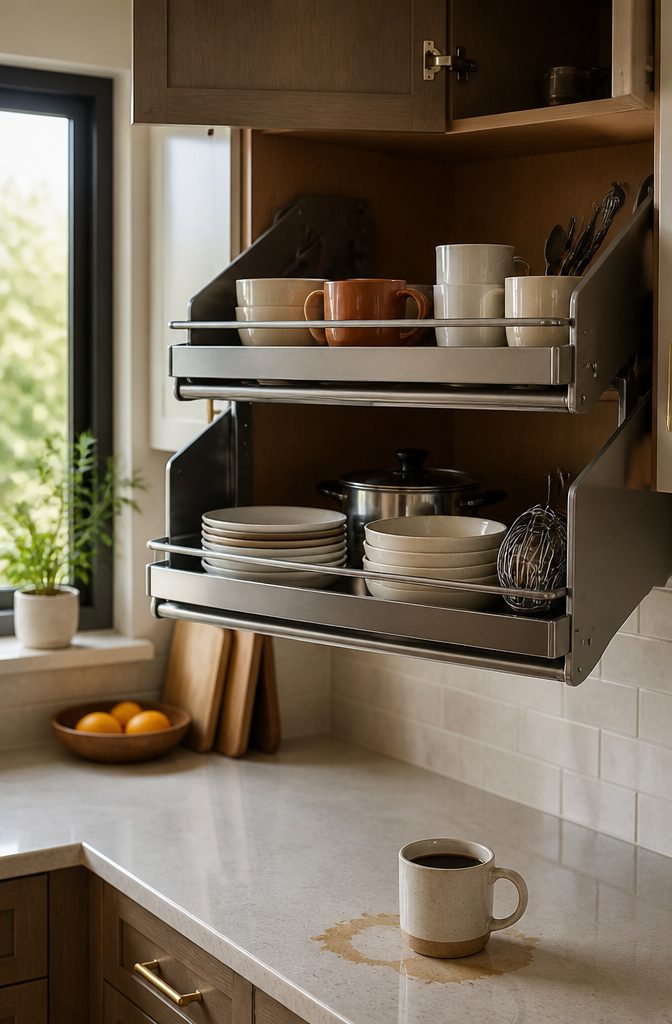
A kitchen cabinet pull down shelf that starts to stick is usually telling you something specific, and the fix depends on whether the problem is grime or wear.
I clean the tracks and arms first, because dust and grease build up fast near a stove or prep area. A dry or slightly damp cloth is enough; harsh chemicals strip the lubrication that keeps the mechanism quiet.
Every six months, I wipe the tracks and check that the mounting screws and pivot points are still tight. Once a year, I look closer at how the shelf moves through its full range.
The difference between dirty and worn shows up in motion, not noise.
A dirty system catches at the same spot and frees up after cleaning. A worn mechanism feels loose or catches in different places each time, or it sags even when the load is within the weight limit and evenly distributed.
Jerking the shelf down or letting it slam up accelerates that wear, so I always use the handle and control the motion both ways.
Respecting the weight limit and distributing items evenly front to back matters more than most people think; overloading is the fastest way to turn a maintenance issue into a replacement.

【Maximize Storage Capacity】 The extended length and multi-tier design of the shelf track help you expand storage space with ease, ideal for organizing and displaying a variety of items.

The updated pull down shelf merged with tempered glass which looks more chic and higher edge.
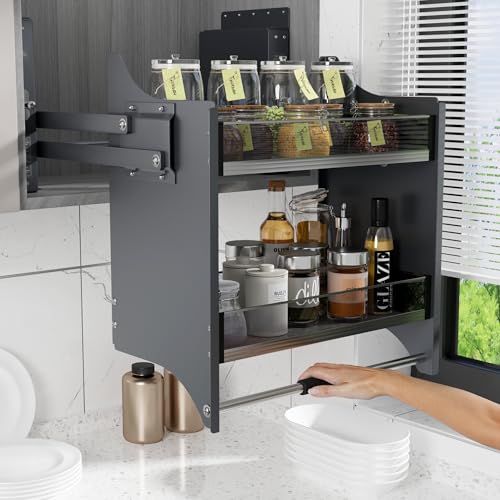
✅【Pull Down Shelf】Are you still worried about wasting space on taller cabinets in your kitchen? Then this convenient 2-tier cabinet pull-down shelving system can help you make full use of the hard-to-reach tall cabinet space, improve space utilization, and you can easily remove items from the cabinets, saving you precious time and energy.
What Pull Down Shelves Actually Change
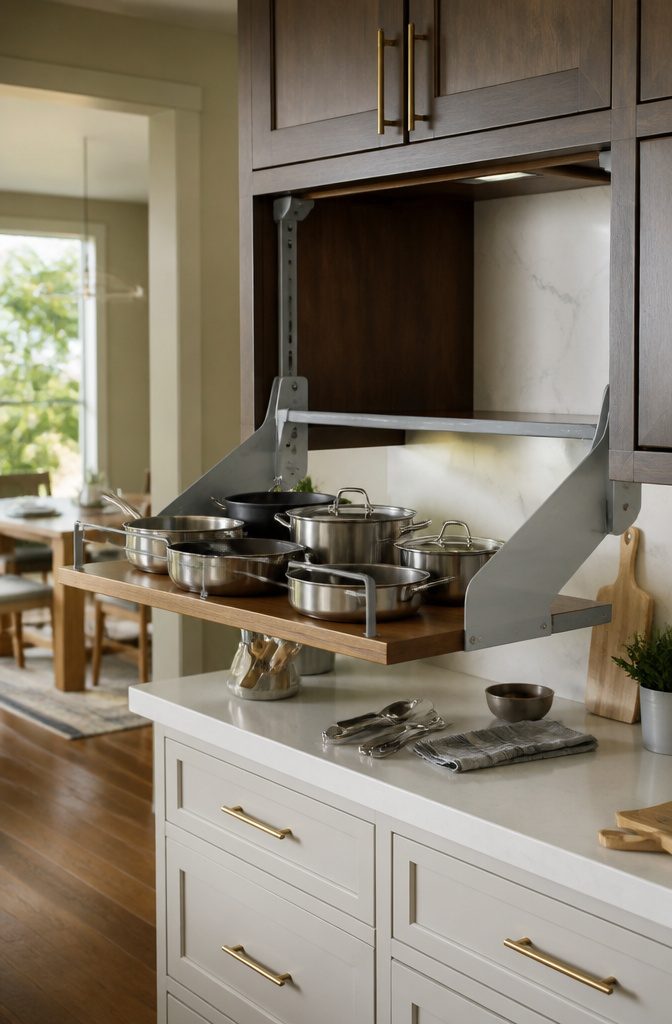
A kitchen cabinet pull down shelf changes four things at once, though not equally.
The reach strain is the obvious fix; shelves glide down to counter height, so you stop stretching over your head or climbing onto a step stool for pasta pots.
I consider that the baseline, not the headline. What actually matters in daily use is how much of the cabinet you finally use.
Deep upper cabinets become dead storage because items migrate to the back and stay there. A pull-down mechanism brings the full depth within reach, which means you store more in the same footprint instead of spreading outward.
Organization follows from access. When you can see the contents without a flashlight and a yoga pose, grouping like items stops feeling like a project and starts feeling automatic.
The workflow speed is real but secondary; you save more time not hunting for the rice cooker than you do on the single motion of lowering a shelf.
Safety and dish protection are genuine benefits, though in my view they are consequences of the core change, not reasons to install on their own.
If you are deciding whether the cost and clearance hassle are worth it, base the call on storage recovery first. The rest is what you get for free.
Sizing Custom Options to Your Cabinets
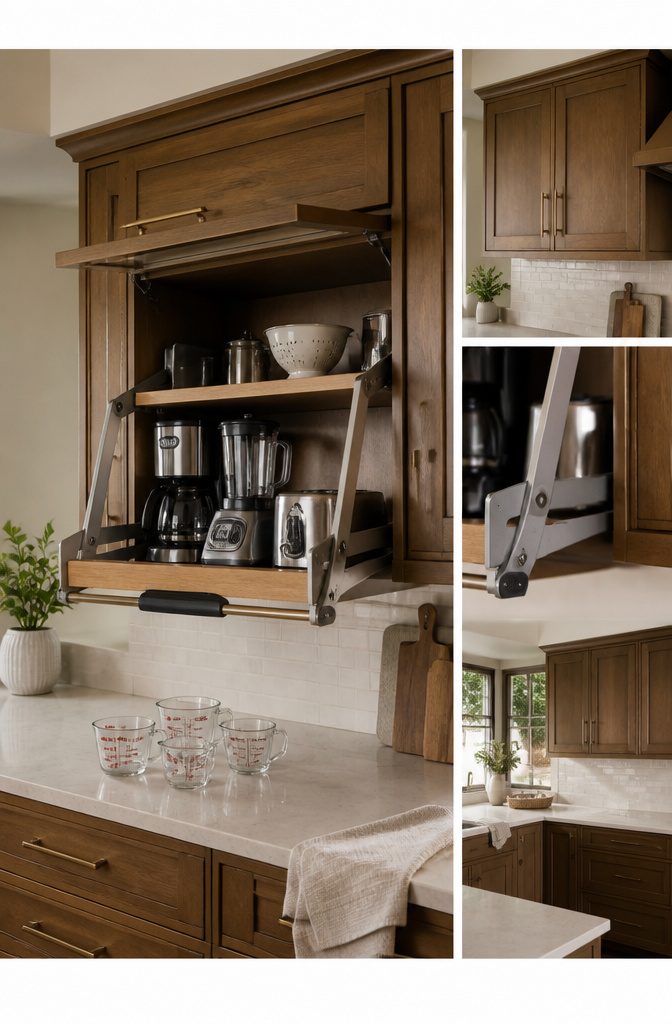
Most pull down shelf systems ship in fixed widths, so a cabinet that measures 27 inches inside will likely need a 24-inch unit with a gap on each side or a fully custom build.
I would ask a shop to quote three things: cutting the frame to my exact width, matching the interior finish so the hardware disappears, and adding soft-close damping so the shelf does not slam.
Gas-assisted systems already descend smoothly, but the lock-in-place models I have seen do not always include damping on the return.
Integrated lighting sounds useful until you price the wiring.
For a weekend install, I would skip it and add a rechargeable puck light later if the shadow bothers me. What matters more is the shelf material.
Wire ventilates well but lets small items tip; laminate-coated particleboard gives a flat surface that behaves like a real cabinet shelf. If I were storing dinnerware, I would pay the slight premium for the solid platform.
Weight capacity is where I would not customize downward. Standard systems rate at 15, 25, or 50-plus pounds, and I would size for the heaviest load I might ever set down, not the average Tuesday.
A custom shop can sometimes upgrade the arms to heavy-gauge steel, though most stock brackets already use thick enough stock that the weak point becomes the cabinet box itself.
Before I signed off on any quote, I would confirm the pull-out depth: the better-known two-tier systems extend 14 3/4 inches forward, which clears most countertops but will clip a kettle left too close.
Frequently Asked Questions
What are pull down shelves for kitchen cabinets?
Pull down shelves are storage systems installed inside upper wall cabinets that lower stored items to counter height using gas shocks, springs, or motorized arms.
They bring the full depth of deep cabinets within reach, which turns dead storage space into usable storage without stretching or using a step stool.
Most systems lower about 10 inches and pull out roughly 14 3/4 inches from the cabinet face to clear the counter edge.
What should buyers check before sourcing pull down cabinet organizers?
Buyers need to measure interior cabinet width, interior depth, and the full arc of clearance below the face frame, because 14 3/4 inches of forward pullout space is what most systems require.
Check whether the cabinet is frameless or face-frame construction, since mounting brackets seat differently on each, and verify side panel thickness so screws hold under loaded weight.
Load capacity and damping type matter too: gas-assisted systems stay smooth at higher weights where springs jerk and wear faster.
What is the difference between a manual pull down shelf and an electric cabinet lift?
A manual pull down shelf uses gas shocks or springs to lower and raise the platform by hand, while an electric cabinet lift uses a motorized drive controlled by a button, voice command, or automation routine.
Manual systems install without wiring and fit weekend retrofits; electric lifts need a dedicated power source inside the cabinet, which usually requires an electrician in finished kitchens.
The electric option suits new builds or aging-in-place remodels where limited grip strength or shoulder mobility makes manual operation difficult.